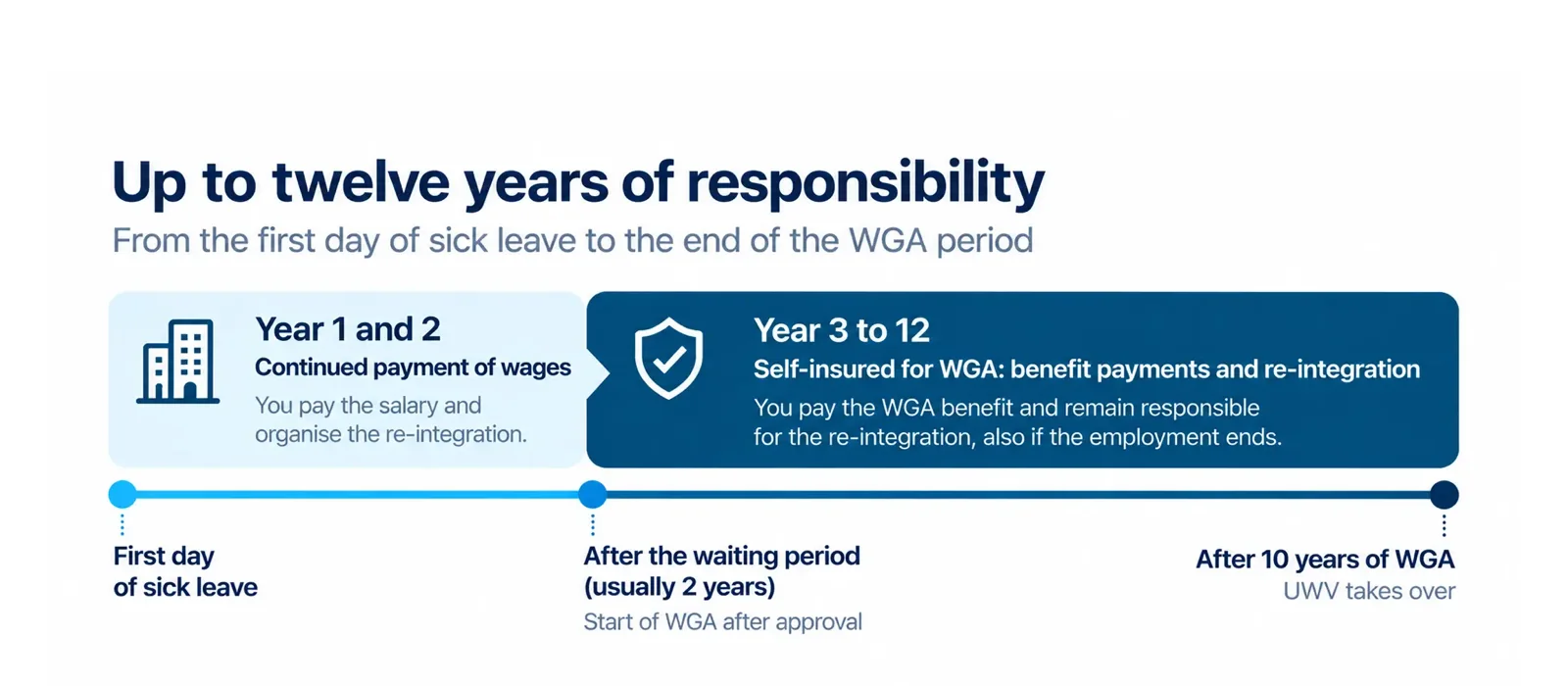
As a WGA own-risk bearer you pay the benefit of your sick and incapacitated (former) employees yourself. That turns every month someone does not return to work into a direct cost. At the same time it gives you something you do not have with UWV: control over the programme, and therefore influence on how long that cost runs. Below is what you have to do, how long you stay responsible and what you are wise to outsource.
What does being a WGA own-risk bearer mean?
You carry the risk for the WGA benefit of your (former) employees yourself, instead of paying a differentiated contribution to UWV for it. You pay the benefit and you organise the reintegration, usually together with an insurer and a provider.
Own-risk bearing can apply to the WGA and to the Sickness Benefits Act. Those are two separate choices with their own duties. Anyone carrying both deals with two different groups: the Sickness Benefits Act covers people without an employer who continues to pay their wages, the WGA covers people declared partly or fully incapacitated after two years of illness. More about the first variant is in own-risk bearer under the Sickness Benefits Act.
How long are you responsible?
From the start date of the WGA benefit you are responsible for the benefit and the reintegration for up to ten years as an own-risk bearer. Add the two years of continued pay and you are looking at a period of twelve years in which the same employee weighs on your costs. After that UWV takes over.
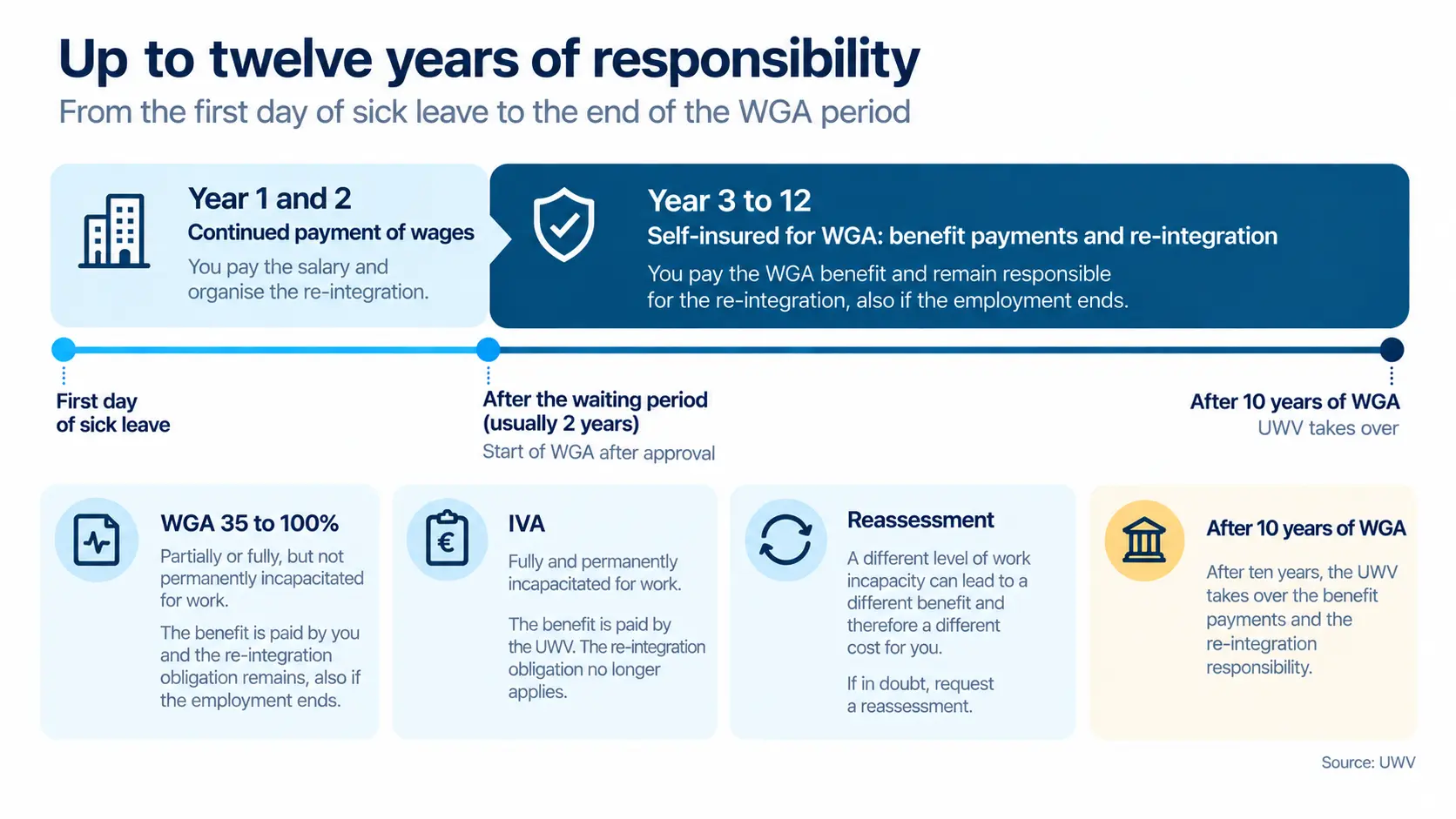
Click the image to view it at full size. Source: UWV.
That term is why early effort pays off more here than for an ordinary employer. Every month you win in the first year can save you years at the end of the road.
If you stop being an own-risk bearer, UWV does not take over your running cases. The benefits that started during your period stay with you, and for (former) employees who are ill at that moment you remain responsible if they are awarded a WGA benefit later on. Always check the exact consequences with UWV, because conditions and terms can change.
Which reintegration duties do you have?
Four things have to be in order, and they hang together.
A reintegration plan that is alive. Not a document drawn up at the start that then disappears into a folder, but a plan you evaluate regularly and adjust when the situation changes.
Offering or finding suitable work. First inside your own organisation, and if that is not possible, with another employer. That is the same principle as in second-track reintegration, only here it continues after the employment ends.
Recording the progress. What you offered, when, and what came of it. This is the dullest part and the only one you can fall back on in a dispute.
Guiding the person towards work with another employer. That is the work you are usually not set up for yourself: finding vacancies, approaching employers, mediating.
If you let this slide, something awkward happens: there is no party correcting you, so it does not show. The benefit simply keeps running at your expense, and the moment a dispute does arise, you have nothing to fall back on. How the benefit itself works is explained in the WGA benefit.
WGA 80 to 100: the duty applies there too
Many employers assume that reintegration no longer makes sense when someone is fully incapacitated. That is not the case, and the difference comes down to one word: permanent.
At WGA 80 to 100 someone is fully incapacitated, but it has not been established that this is permanent. There is prospect of recovery, and so the reintegration duty remains. Only with an IVA benefit, where the incapacity is permanent, does that effort fall away.
That distinction matters financially too: an IVA benefit is not charged to the own-risk bearer. So with long-term full incapacity it pays to have someone assess whether a reassessment is in order.
Do it yourself or outsource it?
You can keep the administrative part in house: the file, the periodic evaluations, the contact with the (former) employee. That asks for discipline, not for a specialism.
Three parts are outsourced in practice, because they need a network or an authority you do not have yourself: the occupational assessment that establishes what someone can still do, the mediation towards another employer, and job coaching at the new workplace.
One instrument is rarely mentioned while it often makes the difference: the no-risk policy. It removes the financial risk for the receiving employer if the employee falls ill again. Raise that argument in the conversation with that employer, not only in your file. It is exactly the doubt that holds a placement back.
For employers: Care4Careers runs the full second-track reintegration for employers, from the occupational assessment and file building to mediation and placement with another employer.
Frequently asked questions about reintegration as an own-risk bearer
Who pays for the reintegration of a former employee?
The own-risk bearer, even when the employment ended long ago. That often comes as a surprise around a settlement agreement: the contract ends, but the WGA costs and the reintegration duty stay with the former employer. Take that obligation into account before you agree to a termination.
Can you reduce the WGA benefit if someone does not cooperate?
As an own-risk bearer you can impose a sanction when someone fails to cooperate with their reintegration without good reason. You do have to show what you offered, when, and what the response was. Without a file a sanction does not hold up, so record every offer and every agreement in writing.
What happens at a reassessment?
A reassessment can lead to a different incapacity category. If someone moves from 80 to 100 per cent to a lower category, the benefit changes and so does your cost. If it results in an IVA benefit because the situation is permanent, that cost moves to UWV.
Does own-risk bearing also apply to employees who were already ill?
That depends on the first day of sick leave, not on the date the benefit started. If that first day of sick leave fell before you became an own-risk bearer, the benefit stays with UWV, even when the WGA benefit only starts afterwards. Only a first day of sick leave during your own-risk period makes the benefit yours.
Part ofWIA, benefits & end of employment
Sources
The legal statements in this article are based on the sources below. Legislation changes; always check the current text for your own situation.
- UWV. (n.d.). WIA benefit. Retrieved on 25 September 2026, from www.uwv.nl/nl/wia
- UWV. (n.d.). Reintegration. Retrieved on 25 September 2026, from www.uwv.nl/nl/ziek/re-integratie
- UWV. (n.d.). Own-risk bearer WGA, what this means. Retrieved on 28 September 2026, from www.uwv.nl/nl/eigenrisicodrager/eigenrisicodrager-wga
- Work and Income (Capacity for Work) Act. (n.d.). Wet WIA. Overheid.nl. Retrieved on 25 September 2026, from wetten.overheid.nl/BWBR0019057
About the author

Program Designer & Project Lead
With over 30 years of experience in HR, project management, and career development, I enjoy working at the intersection of strategy and implementation, always balancing organizational goals with human perspective.
View profile