An outplacement process is professional guidance to new work, intended for employees who lose their jobs due to dismissal, reorganization or a workplace conflict.
The goal: to work quickly and sustainably with another employer.
An outplacement process provides direction and perspective. It helps you process your situation, regain focus and enter the labor market with confidence.
At Care4Careers, we guide employees with personal coaching, practical support and a clear approach - right down to the new job.
When will an outplacement process be deployed?
An employer usually offers an outplacement process when:
- Reorganization or closure of business
- Dismissal by mutual consent
- Conflict or disrupted employment relationship
- Performance issues or mismatch
- Closing social plan or settlement agreement
Outplacement is often included in the dismissal scheme, including agreements about budget, duration and guidance.
Opting for an outplacement process?
Outplacement is not a luxury, but a strategic choice.
For employees, it means: guidance, direction and perspective in an uncertain period.
For employers, it is a way to act socially responsibly, to limit risks and to prevent legal conflicts.
Situations where outplacement is used:
- Reorganization or closure of business
- Dismissal by mutual consent
- Settlement agreement
- Disrupted employment relationship or employment dispute
- Mismatch between job and employee
- Second track reintegration with a view to outflow (external placement)
At Care4Careers, we tailor each process to the unique situation of the employee and organization.
Also read: Who is outplacement for?
The phases of an effective outplacement process
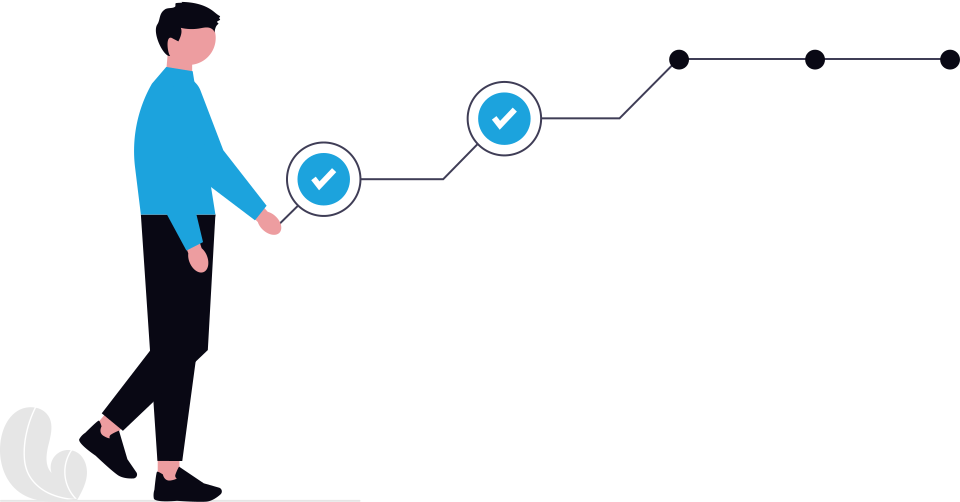
A successful outplacement process consists of five logical, mutually reinforcing steps:
1. Intake & set goals
We start with a personal intake where we discuss the situation, motivation, resilience and expectations. This forms the basis for a customized process.
2. Self-analysis & reorientation
Together, we identify competencies, qualities, pitfalls and motives. What’s right for you? What gives you energy? What are the realistic opportunities?
You can read more about this process at outplacement coaching.
3. Labour market exploration
We explore the labor market, sectors and job opportunities. You’ll discover which roles match your profile - and where the opportunities lie.
4. Job counseling
From CV to LinkedIn, from cover letter to networking conversation: you get concrete tools and personal coaching to present yourself convincingly.
5. Job hunting & coaching until placement
You won’t stay alone. We actively guide you in finding suitable vacancies and stay involved until you actually have a new job.
Also read: Outplacement if you do not return to your old position
Who is an outplacement process for?
Outplacement is for employees who (are going to) lose their jobs and are looking for a new way to fill their career. Think about:
- Employees with a settlement agreement
- Employees who are part of a reorganization
- Employees in long-term absenteeism (outplacement in case of illness)
- Professionals who want to refocus on their career
- Managers who want to enter the labor market stronger with coaching
What does an outplacement process provide?
For employees:
- More self-confidence and control
- New energy and direction
- Practical interviewing skills
- Realistic labour market opportunities
- Sustainable new work
For employers:
- Careful offboarding
- Fewer legal risks
- Reputation preservation
- Comply with social obligations
- Less internal turmoil
Also read: What are the disadvantages of outplacement?
How long does an outplacement process take?
On average, an outplacement process takes three to nine months.
But this isn’t a straitjacket. At Care4Careers, we adjust the duration to:
- The employee’s resilience
- Labour market opportunities
- The degree of reorientation that is needed
We always offer a commitment to placement - not a standard package, but customized guidance to a sustainable job.
Learn more about the duration of an outplacement process.
Who pays for the outplacement process?
In nine out of ten cases, the employer pays for the process, for example via:
- A budget in the settlement agreement
- The transition payment
- A social plan or collective agreement
Tip for employees: Always explicitly set out the outplacement budget in your VSO. This prevents discussions afterwards.
Also read: Transition payment and tax: what can you keep?
Is participation in outplacement mandatory?
No.
However: refusing an offer without substantiation can have consequences. It mainly affects the agreements made in the settlement agreement (vaststellingsovereenkomst, VSO) and possibly your unemployment benefit (WW-uitkering). The statutory transition payment (transitievergoeding) remains a fixed right.
When in doubt, it is wise to seek advice from an independent career coach or lawyer.
Also read: Is outplacement required by law?
Why choose Care4Careers?
Care4Careers has been an expert in outplacement, reintegration and career guidance since 2015.
What sets us apart:
- Customization - not a standard process, but tailored to your situation
- Nationwide coverage - online and on location
- Personal coaching - by experienced professionals
- Proven results - hundreds of satisfied customers preceded you
Outplacement and reintegration: how do they relate to each other?
Sometimes second track reintegration and outplacement are used interchangeably.
For example, when returning to home work is no longer possible and the employer wants to say goodbye in good consultation.
Outplacement is then the logical next step, with a focus on external placement.
Read more about outplacement in case of illness or outplacement at 50+ as an example of specific situations.
A twelve-week programme, step by step
At a financial services firm with around one hundred and eighty employees, the role of an employee with nine years of service disappeared after a department was reorganised.
Week 1. He mostly knew that he did not want exactly the same job again. The intake mapped his experience, his qualities, his wishes and his practical conditions. The first step was therefore not to apply, but to establish which tasks and responsibilities had to reappear in a next role.
Week 4. The possible directions had narrowed to a clearer search area. He had spoken to people doing the work that appealed to him, which adjusted his sense of what was realistic. His CV and LinkedIn profile were then aligned with that direction.
Week 8. He was active on the labour market, with applications under way and an additional contact from his network. Interviews were prepared in advance and reviewed afterwards: which answers and examples could be stronger.
Week 12. That network contact had grown into an application process. After several conversations an offer followed. In twelve weeks his starting point had shifted from a broad sense that it was time for something else to a clear direction and a concrete role.
Summary: why investing in outplacement pays off
Outplacement is more than guidance in the event of dismissal.
It is an investment in:
- The future of employees
- Employers’ due care
- Organizations’ reputation
- The chance for sustainable employability
At Care4Careers, we ensure that people do not fall, but land.
Difference with reintegration: an outplacement process is based on free choice, whereas a track 2 program is legally mandatory in the event of long-term illness.
Frequently Asked Questions
How long does an outplacement programme last?
On average three to nine months. The duration is adapted to the situation; it is not a fixed format.
Who pays for an outplacement programme?
In nine out of ten cases the employer, for instance through a budget in the settlement agreement or from the social plan.
Am I obliged to take part?
No. But refusing an offer without good reason can affect the arrangements set out in the agreement.
All 35 articles on this topic
How a programme runs, what it costs, who pays and what to look for when choosing an agency.
- An outplacement programme in the third track during long-term illness9 minutes
- Are outplacement costs tax-deductible in the Netherlands?6 minutes
- Can you start as a self-employed professional during outplacement?4 minutes
- Designing an Outplacement Programme After Burnout with Care9 minutes
- Group outplacement: moving to new jobs together8 minutes
- Hiring an Older Employee After Outplacement7 minutes
- How do I raise the topic of outplacement?4 minutes
- How do you approach outplacement after burnout?5 minutes
- How does an outplacement process work5 minutes
- How does outplacement work when you are over 50?5 minutes
- How long does an outplacement process take?4 minutes
- How to Choose the Right Outplacement Agencies4 minutes
- Interview training: boost your chances of a new job5 minutes
- Is Outplacement Mandatory in the Netherlands?8 minutes
- Is outplacement required by law?4 minutes
- Optimising Your LinkedIn Profile: Get Found and Find Work8 minutes
- Outplacement coaching: what is it and what does it deliver?5 minutes
- Outplacement Costs for Employers Clearly Explained9 minutes
- Outplacement costs: what does an outplacement process cost?5 minutes
- Outplacement employer: obligations, costs and benefits explained5 minutes
- Outplacement guidance: what does a coach do?5 minutes
- Outplacement if you do not return to your old position4 minutes
- Outplacement in case of illness: what is allowed and what is not?5 minutes
- Outplacement or career guidance?5 minuten
- Outplacement: what is it and when do you choose it?4 minutes
- Preparing for a job interview: tips for success5 minutes
- What are the benefits of outplacement for employees?5 minutes
- What are the benefits of outplacement for employers?4 minutes
- What are the disadvantages of outplacement?3 minutes
- What does outplacement support do for you after dismissal?9 minutes
- When do you offer outplacement as an employer?5 minutes
- Who is entitled to outplacement?5 minutes
- Who is outplacement for?3 minutes
- Who pays outplacement?4 minutes
About the author

Program Designer & Project Lead
With over 30 years of experience in HR, project management, and career development, I enjoy working at the intersection of strategy and implementation, always balancing organizational goals with human perspective.
View profile