A reintegration programme is the whole of the agreements, guidance and actions that bring someone back to suitable work after illness. In the Netherlands that happens along three tracks: track 1 is work with the current employer, track 2 is work with another employer, and track 3 is suitable work from a WGA benefit, after two years of illness. Which track applies depends on what is still medically possible and on how long someone has been ill.
For the first two years the employer and the employee run it together, supported by the occupational physician. After that UWV takes over, or the employer stays responsible if it is an own-risk bearer for the WGA.
This article explains reintegration with a practical focus on track 2: when it should start, how the process works, what UWV checks, and what this looks like in real-life decisions and pacing.
What does a reintegration programme involve?
What is reintegration in the context of long-term sickness absence? It is the set of agreements, actions, and guidance aimed at helping an employee resume suitable work despite medical limitations. “Suitable” means work aligned with the functional capacity assessed by the occupational physician and reasonably expected from both employer and employee.
Reintegration typically follows two routes. First, the employer explores return to the original job or other internal roles, often referred to as first-track reintegration. If that is not realistic, the second route is external: track 2 reintegration, aimed at placement with another employer.
Track 2 exists to avoid stagnation. If internal return is unlikely, timely external orientation improves the chance of sustainable placement and supports a defensible reintegration record for UWV assessment.
- Goal: sustainable return to suitable work as soon as possible.
- Track 1: return to work with the same employer.
- Track 2: suitable work with a different employer.
- Assessment: UWV evaluates whether efforts were sufficient.
The difference between track 1, 2 and 3
| Track | Where | When | Responsible |
|---|---|---|---|
| Track 1 | With the current employer: the same role, adapted work or another role | From the first day of sick leave | Employer and employee |
| Track 2 | With another employer | As soon as a return to the current employer does not work, at the latest at the first-year evaluation around week 52 | Employer and employee, often with a reintegration agency |
| Track 3 | Suitable work from a WGA benefit | After 104 weeks of illness and the WIA assessment | UWV, or the employer as own-risk bearer for the WGA |
Track 1: back with the current employer
Track 1 is reintegration with the current employer. It starts on the first day of sick leave and looks in turn at the original role, that role with adjustments, and other work inside the same organisation. The occupational physician establishes what someone can still manage; employer and employee fill in what fits. More on this in first-track reintegration.
Track 2: work with another employer
Track 2 is reintegration with another employer. It comes into view as soon as it becomes clear that a return within the current organisation will not work, and it has to have started by the first-year evaluation at the latest. The employee stays employed throughout track 2; only the search area moves outside. Many employers bring in a reintegration agency for this.
Track 3: work from a WGA benefit
Track 3 is reintegration from a WGA benefit, so after two years of illness and the WIA assessment. By then the employment has often ended. The guidance sits with UWV, unless the employer is an own-risk bearer for the WGA; in that case the employer stays responsible, for up to ten years from the start date of the benefit. The detail is in third-track reintegration, and what being an own-risk bearer means for an employer is covered in reintegration as a WGA own-risk bearer.
Can track 1 and track 2 run at the same time?
Yes, and often that is the sensible choice. If a return to the current employer is uncertain but not ruled out, track 2 can start while track 1 continues. If track 1 works out after all, track 2 simply stops. If it does not, no months were lost waiting, and that counts at the UWV assessment.
The reintegration timeline in weeks
The Gatekeeper Improvement Act runs on weeks, counted from the first day of sick leave. These are the moments that matter:
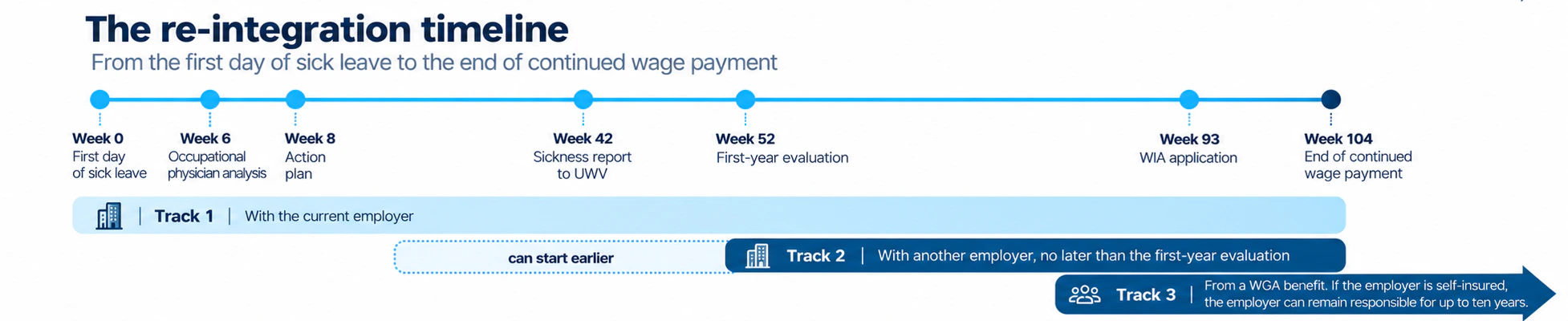
- Week 6: the occupational physician produces the problem analysis, with the capacity for work and the outlook for recovery.
- Week 8: employer and employee record the action plan, with goals and evaluation moments.
- Week 42: the employer reports the long-term absence to UWV.
- Week 52: the first-year evaluation. If there is no prospect of a return to the current employer by then, track 2 should be running.
- Week 93: the WIA application goes to UWV, together with the reintegration report.
- Week 104: the obligation to continue paying wages ends, unless UWV imposes a wage sanction because too little was done. Track 3 begins after that.
Those weeks are not a formality. At the WIA application UWV looks back along exactly these moments and judges whether enough was done in time.
When should track 2 start under the Gatekeeper Act?
What is reintegration from UWV’s perspective? UWV expects a structured approach with timely adjustments. The Dutch Gatekeeper Improvement Act sets out process steps and timelines. Track 2 should not be postponed until the very end; it should start once it becomes clear that internal return is not feasible within a reasonable time.
In practice, this point often follows a period where track 1 has not delivered realistic prospects. The occupational physician clarifies functional capacity and prognosis. Often, a labour expert assessment helps determine what is suitable and whether internal options are genuinely available.
Starting too late can have consequences. At the WIA application stage, UWV can decide that reintegration efforts were insufficient, potentially leading to a wage sanction (extended wage payment obligation). That makes timely, well-documented decision-making essential.
- Start track 2 when internal return is not feasible or not timely feasible.
- Support the decision with occupational physician advice and often labour expertise.
- Document changes in goals and actions in the reintegration plan.
- Delays increase the risk of UWV judging efforts insufficient.
What does a track 2 process look like in practice?
What is reintegration in track 2 on a practical level? It is a step-by-step trajectory: determining feasibility and direction, then actively searching and working toward placement. Many employers use specialized support to keep activities structured, measurable, and aligned with medical capacity. A useful reference point is how to start a track 2 trajectory once the framework is clear.
A key foundation is the reintegration action plan, which sets objectives, evaluation moments, and concrete actions. In track 2, this often includes labour market orientation, translating limitations into job requirements, rebuilding work rhythm, and carrying out suitable applications.
Example: an employee in a physically demanding role can no longer lift or stand for long due to back problems. If no sustainable internal alternatives exist, track 2 targets roles with different demands, such as planning or administrative support, possibly combined with training and gradual hour build-up.
- Intake and framework: capacity, conditions, experience, preferences.
- Profile and direction: suitable roles and realistic labour market choices.
- Action: CV, motivation, networking, applications, employer outreach.
- Return to work: placement and gradual build-up, with evaluations.
- Documentation: demonstrable activities and periodic adjustments.
Responsibilities: employer, employee, physician, case manager
What is reintegration without clear responsibilities? It often leads to delays and disputes about “sufficient effort”. The employer must organize and fund reintegration, while the employee must cooperate with reasonable proposals that fit medical capacity. UWV expects both parties to remain active, even if cooperation is difficult.
The occupational physician is the medical gatekeeper: assessing functional capacity and advising on possibilities, without making employment-law decisions. In track 2, the occupational physician’s role often determines pacing, hour build-up, and whether external steps are appropriate.
HR or a sickness absence case manager safeguards deadlines, schedules evaluations, and ensures documentation. It helps to understand the employer’s reintegration obligations and the employee’s reintegration obligations so expectations remain realistic and consistent.
- Employer: process control, offering suitable work, organizing and funding.
- Employee: staying reachable, cooperating, engaging with suitable steps.
- Occupational physician: medical assessment and advice on capacity.
- Case manager/HR: process monitoring, documentation, coordination.
What does UWV assess and what documentation is expected?
What is reintegration considered “sufficient” by UWV? UWV primarily reviews the reintegration report submitted with the WIA application: timeliness, suitability of actions, adjustments when needed, and whether decisions were logically supported. UWV does not require a successful placement, but it does require demonstrable, appropriate effort.
Documentation is central. A strong record shows what was attempted, why certain steps were chosen, and what outcomes followed. The action plan and evaluations are the backbone, supplemented by guidance reports, application logs, and, where applicable, labour expert findings. Capacity and hour build-up agreements should align with occupational physician advice.
In track 2, it is especially important to explain why no sustainable internal solution existed and why external directions were suitable. Clarity about rights and obligations in track 2 helps keep the process fair and expectation-driven.
- Plan and evaluations: goals, actions, results, and adjustments.
- Medical basis: occupational physician advice on capacity.
- Track 2 activities: orientation, networking, applications, outreach.
- Rationale: why internal return failed and external options were suitable.
Practical examples: what counts as “suitable work” in track 2?
What is reintegration without a concrete view of suitable work? It becomes abstract and can trigger conflict about targets being too ambitious or too limited. Suitable work in track 2 fits medical capacity, matches skills or realistic development potential, and exists in the labour market. It does not have to match the previous role or salary, but it must be reasonable.
Example 1: a manager recovering from burnout may not be ready for high-pressure leadership. Suitable work could be a supporting coordination role with clear boundaries and gradual hour build-up. Example 2: a mechanic with lasting shoulder limitations may transition toward work preparation or quality control if tasks are mostly seated and avoid overhead lifting.
In both cases, it helps to define roles by load factors (lifting, time pressure, sensory overload, responsibility peaks) and match them to what is feasible. This prevents track 2 from turning into random applications and supports a coherent UWV-proof narrative.
- Physically suitable: limited lifting, standing, repetition, overhead work.
- Mentally suitable: controlled stimuli, responsibility, and deadlines.
- Organizationally suitable: predictable hours, clear tasks, supervision.
- Labour-market suitable: roles that are demonstrably available and realistic.
Common misconceptions about reintegration and track 2
What is reintegration not? It is not a one-sided demand placed on the employee while the employer waits. Track 2 is also not a disguised dismissal route. It is a legal reintegration pathway to create work prospects when internal return is unlikely, with UWV assessing reasonableness and effort.
Another misconception is that track 2 can only start once someone is fully recovered. In reality, it can run alongside recovery, as long as activities match capacity. That may include low-intensity labour market orientation or employer conversations without exceeding medical limits.
Finally, “suitable work” is not the same as “dream work”. However, it also should not be a dead-end step back. A well-designed track 2 approach targets realistic, sustainable options and makes development steps concrete through training, work rhythm, and adjustments.
- Track 2 is a reintegration effort, not a dismissal strategy.
- Full recovery is not required to start suitable track 2 activities.
- Suitable work is reasonable and feasible, not necessarily identical to the old job.
- A demonstrable record is part of the process, not just paperwork.
More information at the UWV
The official rules and current amounts or deadlines are available at UWV about reintegration. These can change, so always check them at the source itself for a concrete situation.
Track 2 in practice: what does structure change?
What is reintegration in track 2 when organized well? It becomes a predictable process with clear goals, measurable actions, and regular evaluations. Employees benefit from direction and reduced uncertainty. Employers benefit from a more defensible process and fewer UWV assessment risks.
Structure often comes from practical choices: fixed check-ins, an activity log, and clear agreements on what “enough” job search looks like given capacity. It also helps to keep reviewing internal options alongside external search, so opportunities within the organization are not missed.
For a broader view of how the trajectory is typically set up, the track 2 reintegration trajectory provides a useful framework: phases, roles, and how progress can be monitored without losing the human side of recovery.
- Calm: pacing aligned with functional capacity.
- Direction: role choices and sectors are evidence-based.
- Outcomes: actions lead to interviews, trial placements, or placement.
- Auditability: UWV sees a coherent, consistent, complete story.
Frequently asked questions about track 1, 2 and 3
Can track 1 and track 2 run at the same time?
Yes. If a return to the current employer is uncertain, track 2 can start while track 1 is still running. That way no time is lost if track 1 does not work out after all.
When does track 2 have to start at the latest?
As soon as it is clear that a return to the current employer will not work, and at the latest at the first-year evaluation around week 52 if there is no prospect of return by then.
Does track 2 mean the employee is being dismissed?
No. During track 2 the employee stays employed by the current employer. The programme looks for suitable work with another employer.
Who is responsible for track 3?
After two years of illness the reintegration sits with UWV. If the employer is an own-risk bearer for the WGA, the employer stays responsible, for up to ten years.
What happens if an employer does too little about reintegration?
UWV can impose a wage sanction. The employer then keeps paying wages for up to one extra year.
Part ofSecond track in practice
Sources
The legal statements in this article are based on the sources below. Legislation changes; always check the current text for your own situation.
- UWV. (n.d.). Beoordeling re-integratieverslag. Retrieved on 13 August 2026, from www.uwv.nl/nl/ziek/re-integratie/beoordeling-re-integratieverslag
- UWV. (n.d.). Re-integratie bij ziekte. Retrieved on 13 August 2026, from www.uwv.nl/nl/ziek/re-integratie
- Wet werk en inkomen naar arbeidsvermogen. (n.d.). Wet werk en inkomen naar arbeidsvermogen (Wet WIA). Overheid.nl. Retrieved on 13 August 2026, from wetten.overheid.nl/BWBR0019057
About the author

Program Designer & Project Lead
With over 30 years of experience in HR, project management, and career development, I enjoy working at the intersection of strategy and implementation, always balancing organizational goals with human perspective.
View profile