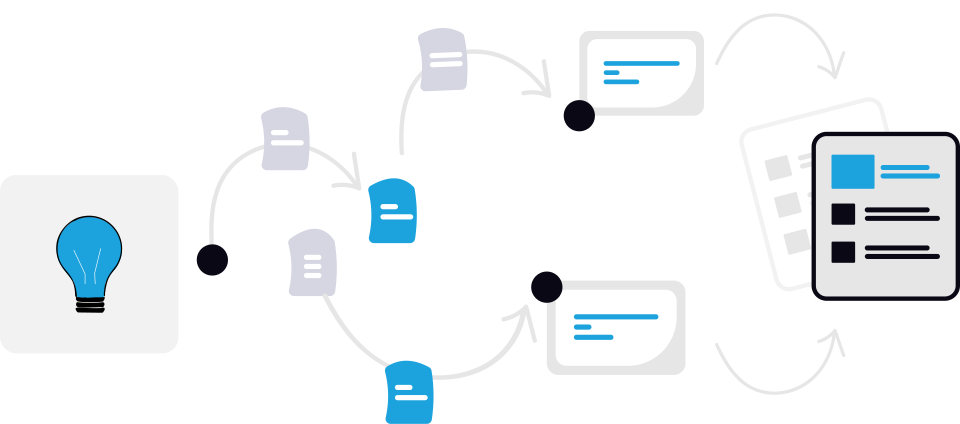
An action plan for reintegration (plan van aanpak re-integratie) is the written, joint plan by employer and employee that sets out how return to work will be achieved under the Dutch Gatekeeper Improvement Act (Wet verbetering poortwachter). In track 2 (spoor 2), the focus shifts to suitable work with a different employer because sustainable return within the original role or organisation is not feasible. The plan documents goals, actions, timelines and evaluation moments so the approach is transparent and assessable by UWV. This article explains how to build a practical, UWV-proof plan for spoor 2, with examples and common pitfalls.
In spoor 2, success depends on structure: medical employability (what someone can do) must translate into realistic labour-market steps. That requires a plan that is specific enough to steer progress and flexible enough to adjust when circumstances change.
When should the reintegration action plan be updated for spoor 2?
The action plan typically starts early in absence management, but it needs a clear update once spoor 2 becomes relevant. Spoor 2 is considered when returning to the employee’s own work (track 1) is not feasible, or when track 1 efforts do not offer realistic prospects. Practically, that means adding or revising the plan with actions aimed at placement outside the organisation.
Plan van aanpak re-integratie and spoor 2 belong together once the occupational physician (bedrijfsarts) or occupational health service indicates that sustainable return to own or adjusted work within the organisation is unrealistic. That medical advice matters because UWV will later assess whether choices were consistent with medical and labour-market logic. The plan should show spoor 2 as a reasoned step, not a last-minute attempt.
A good moment to revise the plan is after an evaluation where goals are not met, or when work capacity changes. Record what was tried in track 1, why it was insufficient, and why the spoor-2 route is appropriate. This also supports a file that can withstand scrutiny, such as a UWV-proof reintegration file.
- Trigger: structural limitations or no suitable internal role available.
- Evidence: up-to-date advice from the occupational physician on capacity.
- Decision: joint agreement to start and plan spoor 2.
- Translation: add concrete spoor-2 actions with deadlines and evaluations.
What must be included in a reintegration action plan for spoor 2?
A plan van aanpak re-integratie in spoor 2 must specify how the employee moves toward sustainable suitable work outside the organisation. UWV does not require perfect predictions, but it does expect a coherent approach: goals, actions, responsibilities and evaluations aligned with employability. General statements are hard to test; measurable agreements are not.
Start with the practical baseline: what restrictions apply, what remains possible, and which conditions matter (hours, commuting, physical or mental load). The medical details are not written into the plan, but the translation into work criteria is. Clarify who does what and by when.
Then include labour-market actions that fit spoor 2: profiling, target roles, networking, applications, interviews and, where appropriate, a work trial placement. Link each action to a timeframe and evaluation moment to show active steering. Aligning the plan with a clear Gatekeeper Act step-by-step approach helps prevent gaps.
- Goal: a realistic end goal (for example placement in suitable work with another employer).
- Actions: concrete steps (labour-market orientation, applications, networking).
- Capacity: conditions translated into work criteria (hours, tasks, stimuli).
- Evaluations: fixed moments to adjust and document outcomes.
- Responsibilities: employer, employee, case manager and external support.
Practical example structure: from goals to actions and timelines
Action plans often fail because they remain too generic and therefore do not guide execution. A practical structure uses short cycles: agree what will be done, what outcome is expected, and how the result will be assessed. Next, adjust based on what is learned from the labour market and capacity changes.
Example: an employee in logistics cannot lift or stand for long periods due to back issues. No sustainable seated role exists internally. A useful spoor-2 goal could be: “Within three months, identify placement options in predominantly seated work for 20-24 hours per week, with limited lifting and alternating posture.” This is specific enough to steer the trajectory.
Then detail the actions: define a target profile, create a CV focused on seated roles, approach network contacts, and schedule applications. If a work trial is appropriate, document how it will be used and evaluated, for example via a spoor-2 work placement.
- Weeks 1-2: define profile and target roles, including capacity-based criteria.
- Weeks 3-6: finalise CV and motivation, plan and conduct networking meetings.
- Weeks 7-10: targeted applications and interviews, document progress weekly.
- Weeks 11-12: evaluate and adjust the target direction or start a work trial.
Who does what: employee, employer, physician, case manager
An action plan only works when responsibilities are explicit. The employer must manage the process and enable reintegration. The employee must cooperate with reasonable proposals and complete agreed actions. In spoor 2, coordination between medical guidance and labour-market steps is essential, otherwise goals may be unrealistic.
The occupational physician assesses capacity and advises on limitations and possibilities in relation to work. The plan should not include medical details, but it should reflect them in work criteria and decisions. It is therefore sensible to include the role of the occupational physician in spoor 2 in evaluation and adjustment moments.
The absence case manager monitors deadlines, organises evaluations and supports documentation. In many organisations this is an HR professional or an external specialist. For a practical benchmark, it helps to use the responsibilities of a verzuim case manager as a reference.
- Employer: process control, resources, decisions and documentation.
- Employee: active participation, executing actions and reporting progress.
- Occupational physician/OHS: capacity assessment and medical underpinning.
- Case manager: timeline control, file quality and evaluation planning.
Evaluate and adjust: keeping the plan UWV-proof
A plan van aanpak re-integratie is a working document that must be evaluated periodically. UWV assesses efforts when a WIA application is made: were steps taken in time, were choices substantiated, and was the approach adjusted when needed? Skipping evaluations or recording only “no result” creates avoidable risk.
The plan becomes stronger when evaluations are tied to outcomes: number of networking meetings, responses to applications, adjusted target roles, or changes in hours build-up. Also document why something did not work, such as labour-market scarcity in suitable roles or a temporary setback in capacity. This makes the process understandable rather than defensive.
Use fixed review moments and record key decisions in your reporting. A solid reintegration report should align with the plan and show how actions and results developed. For the meetings themselves, a clear structure helps, as in conducting a reintegration meeting with a focused agenda.
- Schedule fixed evaluations (for example every six weeks) and document decisions.
- Make results measurable: numbers, dates, concrete feedback and next steps.
- Explain adjustments: what changed and why the new direction is logical.
- Keep evidence: vacancies, emails, meeting notes and agreed actions.
More information at the UWV
The official rules and current amounts or deadlines are available at the UWV Werkwijzer Poortwachter. These can change, so always check them at the source itself for a concrete situation.
Common spoor-2 mistakes and how to prevent them
In spoor 2, action plans often fail on specificity and timing. A plan that only states intentions (“the employee will orient”) is difficult to assess and does not drive placement. Starting too late, without explaining why track 1 is no longer realistic, can raise questions during UWV assessment.
Another common mistake is confusing “suitable work” (passende arbeid) with “any work.” Suitable work must fit medical capacity, skills and education level, and be reasonable. If the target direction is too broad, the process becomes noisy; too narrow, and opportunities are missed. The plan should show targeted searching within realistic boundaries, consistent with rights and obligations in spoor 2.
Finally, do not underestimate the value of professional structure and guidance. A clearly defined spoor-2 reintegration trajectory helps accelerate actions and keep documentation consistent. It does not guarantee placement, but it does support demonstrable, coherent effort.
- Overly generic plan: avoid vague actions without deadlines or metrics.
- No spoor-2 rationale: document what was tried in track 1 and why it was insufficient.
- Unrealistic goals: align target roles with capacity and the labour market.
- Weak documentation: connect plan, evaluations and evidence into one storyline.
- No course correction: change direction when results stall and record why.
Part ofGatekeeper, records & wage sanction
Sources
The legal statements in this article are based on the sources below. Legislation changes; always check the current text for your own situation.
- UWV. (n.d.). Werkwijzer Poortwachter: een quick start. Retrieved on 13 August 2026, from www.uwv.nl/nl/ziek/werkwijzer-poortwachter
- Wet verbetering poortwachter. (n.d.). Wet verbetering poortwachter. Overheid.nl. Retrieved on 13 August 2026, from wetten.overheid.nl/BWBR0013063
About the author

Program Designer & Project Lead
With over 30 years of experience in HR, project management, and career development, I enjoy working at the intersection of strategy and implementation, always balancing organizational goals with human perspective.
View profile